Property letting: is it a repair or an improvement?
During the coronavirus lockdowns, many landlords may have taken the opportunity to carry out work on their properties - especially if these have been empty. How can they differentiate between "repairs" and "improvements" in order to maximise income tax relief?
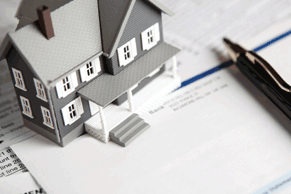
Changing rules
In the last decade landlords of residential properties have had to cope with more changes to the tax rules than any other group. The changes have affected the tax treatment of income and outgoings. Here we will take a close look at repair and improvement costs.
Room for improvement or just repair?
As a general rule, a “revenue” tax deduction can’t be claimed for the cost of improving a property. A revenue deduction reduces the amount of rental income liable to tax. Instead, the cost is “capital” and so deductible when working out the capital gain or loss made when selling the property. Landlords might therefore have to wait decades for a tax deduction.
Conversely, the cost of repairing a property is a revenue expense and so reduces the income tax bill on rent for the year of expenditure. Naturally, it’s in the landlord's interest to attribute a cost to repairs rather than improvements.
Grey areas
Sometimes the distinction between a repair and an improvement isn’t clear and the tax legislation doesn’t provide any help. For example, if the owner adds a conservatory to a rental property it’s an improvement cost. But what if they completely replace an existing conservatory that had become dilapidated?
As a rule, an addition to a property, e.g. creating a new room by converting a loft or garage, will always be an improvement.
Partial or total repair?
The replacement of an entire element of a property may be a repair or an improvement. The scale and cost of works aren’t usually a factor. For example, the roof of a property was lost in a storm and replaced with equivalent materials; that would be a repair despite improving the value of the property. At one time HMRC usually argued that a repair that significantly affected the value of a property should be treated as an improvement (and so a capital expense) for tax purposes. These days its approach has softened.
As a rule of thumb, a like-for-like repair or replacement using similar materials to the original counts as a repair regardless of the scale. HMRC’s property income manual (PIM) confirms this. There’s an exception for such expenditure where the repair work is carried out on a property soon after purchase and the cost of the repairs was reflected in the price paid for the property.
Property fixtures
Repairing or replacing equipment which is fixed to the property and has effectively become part of the structure, e.g. a heating system including a boiler, is treated in the same way as the structure. For example, a like-for-like replacement boiler and radiators is a repair and the cost qualifies for a revenue deduction. However, if the work included the addition of an extra radiator, the corresponding proportion of the cost would be capital.
Related Topics
-
Why is HMRC checking PVA more often?
Your business imports goods and accounts for VAT by applying postponed VAT accounting (PVA) on its returns. HMRC is scrutinising returns and issuing large assessments in some cases. What can you do to reduce the risk of getting it wrong?
-
HMRC text or scam? Check before you act
HMRC is contacting some taxpayers by text this week about overdue Self Assessment liabilities and is also sending updates about VAT registration applications. At the same time, it has expanded its guidance on spotting fake HMRC messages on social media. How can you tell whether a message is genuine?
-
Electronic VAT return and payment due